


🎯 IN BRIEF
- If you’re looking for convenience, price and ease of maintenance, the Digital piano is the right choice.
- B♯ If you’re looking for a more accomplished touch, an authentic sound and the depth of a living instrument, the acoustic piano is still a must.
It all started with a dream: to learn the Piano. As you explored this instrument, you quickly realized why it’s one of the most popular in the world. The piano is incredibly versatile, adapting to every musical genre, from classical to jazz to pop.
Whether you play with scores or by ear, compose your own pieces or cover existing tracks, the piano offers you exceptional musical freedom. A complete, expressive and accessible instrument that lets you explore everything. 🎹
Yes, but now that you know you want to play the piano and you’re ready to take the plunge, the big question is: Which instrument should you choose? A piano with Strings or a digital piano? 🤔
In this article, we’ll show you the real differences between digital and acoustic pianos, and help you make the best choice according to your criteria.
Comparison table
| Criteria | Digital piano | Acoustic piano |
| Input budget | Accessible from ~500 CHF | Higher investment, often equivalent to a high-end digital piano |
| Size | Compact, can sometimes be dismantled | Very heavy and bulky |
| Maintenance | No tuning, minimal maintenance | Annual tuning and mechanical maintenance |
| Touch | Weighted Keyboard simulates piano action | Genuine mechanics with Hammers and natural resistance |
| Sound | Sampled sounds, sometimes multiple instruments | Sound produced by real Strings and wood Resonance |
| Resale | Faster depreciation | Steadier depreciation, Ageing from 30 onwards |
Concrete differences: digital vs. acoustic
First of all, what’s the concrete difference between a Digital piano and an Acoustic piano?
The Digital piano: is an electronic instrument designed to mimic the sound, touch and feel of an acoustic piano. It uses digital sound samples to reproduce the sounds of piano and other instruments. Lightweight and often portable, the Digital piano is an option for those with space or budget constraints.
The Acoustic Piano: An upright or grand piano operates with a mechanism and strings. When a key is pressed, the piano’s action sets a Hammer in motion. This strikes the corresponding Strings, creating a vibration that produces sound. Each note has its own dynamic and character, depending on the strength and technique of the pianist. Acoustic pianos offer a much richer, authentic playing experience.
Noise in the apartment: the solutions
⚠️⚠️⚠️ Do you think an acoustic piano is too noisy for an apartment? Think again! All Acoustic pianos can be transformed into Silent Pianos. 🎧
Yes, you read that right: all you need are a pair of headphones and… you can play in silence, at any time, without disturbing anyone. Your music, your bubble, your moment.
And that’s not all! Some TransAcoustic™models even let you adjust the volume directly on the piano. Practical, isn’t it?
So, if you’re hesitating between Digital piano and Acoustic because of the noise, good news: there are solutions for playing without disturbing those around you 😉
“If you’re in the building, come and try out the Headphones sensation with us and discover everything we can do with a Silent.”
Which piano should I choose? Which one is best suited to my needs?
Each has its own advantages and disadvantages, and the ideal choice depends above all on your desires, your goals and your living environment.
Digital piano: modernity and flexibility
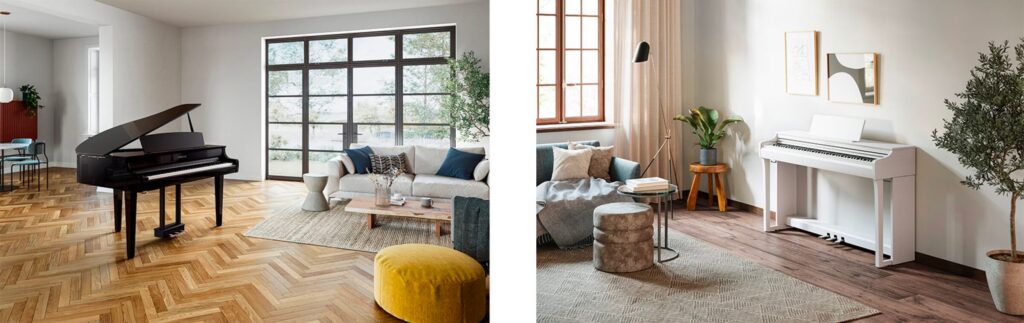
✅ Advantages:
- Lightweight and compact: it’s easy to move and can sometimes be dismantled
- Maintenance-free: no annual tuning required
- More affordable price: starting at 500.- CHF, it’s already possible to find some very interesting models.
⚠️ Disadvantages :
- Less natural sound and touch: they are simulated, which reduces sensations and realism under the fingers.
- Limited expressive features: certain subtle nuances and techniques are more difficult to reproduce.
- Rapid depreciation: its value decreases faster than an acoustic instrument, especially with the rapid evolution of technology.







Acoustic Piano: tradition and authenticity
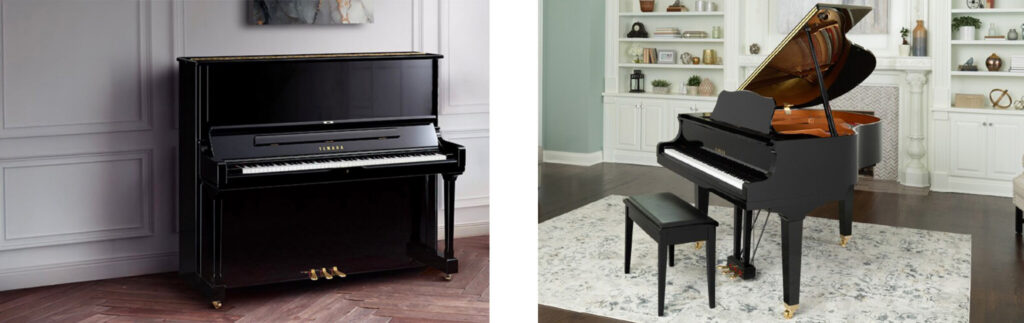
✅ Advantages :
- Unrivalled sound quality: nothing can replace the vibration of the Strings and the resonance of the wood of a real piano.
- Incomparable Touch: the Hammers, mechanics and strength of the keys offer an expressive, nuanced experience.
- Durability: an acoustic piano can last a lifetime and live to be a hundred.
⚠️ Disadvantages :
- Annual maintenance: composed of Strings, wood and Felt, the piano needs tuning at least once a year.
- Size and weight: very heavy and difficult to move.
- Higher price: the first price for an Upright piano is equivalent to that of a high-end digital piano.



🏁 Verdict: how to choose?
If you’re looking for practicality, price and ease of maintenance, the Digital piano is the right choice.
If you’re looking for a more accomplished Touch, an authentic sound and the depth of a living instrument, the acoustic piano is still a must.
💡 Conclusion
In the end, there’s no “wrong” choice: it all depends on you, your desires and your possibilities. If you’re looking for practicality, flexibility and an affordable price, a Digital piano could be the ideal companion for starting out and progressing without constraints. If you want to feel every vibration, develop a deep bond with your instrument and invest in a lasting, expressive experience, an acoustic piano will give you all the richness and soul your playing deserves. 🎹
The important thing is to start playing and blossoming with the piano you choose, because every note you play is already a step towards your own music.
Come and test the difference in touch (weighted vs. mechanical keyboards) and “silent” solutions directly in our showrooms in Morges.
FAQ
What’s the right budget to get started?
Starting at $2,000 for a digital piano, you start to get a wooden touch with a more realistic sound engine and a more advanced keyboard. For an Acoustic piano, starting at 6,000, you’ll get a piano that’s more expressive and precise than the basic student models.
Of course, second-hand pianos overhauled by professionals can be a good way to get top-quality pianos at more affordable prices.
Is a Digital piano enough to get into a conservatoire?
Not always. Some conservatories even require students to have an Acoustic piano.
What is the minimum touch required?
A weighted touch* is preferable. It helps develop finger muscles, learn Dynamic (sound intensity) and eases the transition to a real piano.
*A weighted Touch: a term used only for Digital pianos, as all Acoustic pianos already have a heavy touch.
Silent on acoustic: is it still possible?
Yes, it’s still possible, but a factory-installed system guarantees greater reliability and preserves the touch.
What should I choose if I live in an apartment?
All pianos are possible if you live in an apartment. With the Digital piano, you can adjust the volume and connect headphones to any model. With an acoustic piano, you can plug in headphones if it’s Silent, adjust the volume if it’s TransAcoustic™ or mute the sound if you don’t want to disturb the neighbors. Some models even have Silent and Mute at the same time.